
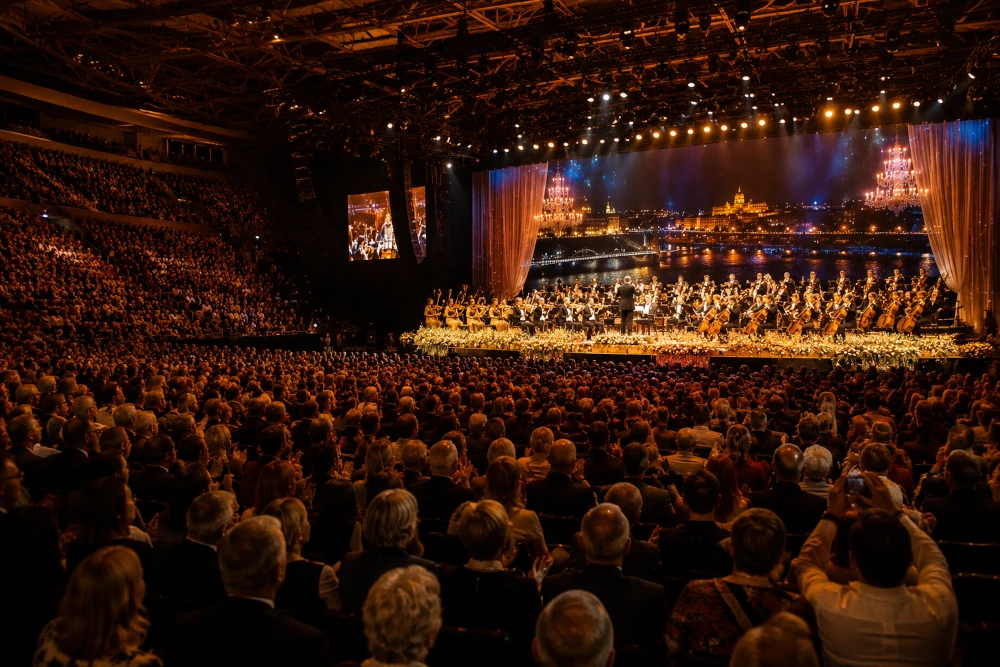
Somewhere in Europe tonight, an arena is filling with tens of thousands of people who have come, once again, to hear a waltz. The lights dim, a violin lifts above the murmur of the crowd, and for a few hours an entire generation gap simply disappears. This is not a nostalgia act clinging to former glory. It is André Rieu, more than forty years into his career, still selling out the very same venues that host the biggest names in pop and rock. The question worth asking isn’t whether he can still fill an arena. It’s why, after all this time, nothing seems to have slowed him down.
A Career Built on Connection, Not Just Music
Most classical performers are remembered for their technical mastery. André Rieu is remembered for something rarer: the feeling of being invited somewhere. From the earliest Maastricht concerts to today’s global tours, his shows have never really been about showcasing virtuosity for its own sake. They have been about creating a shared moment, one that feels intimate even when it happens in front of fifteen thousand people.
That distinction matters. Classical music has often been framed as something to be studied, admired from a respectful distance, or preserved as heritage. Rieu took a different path. He turned the concert hall experience into something closer to a celebration, complete with costumes, storytelling, dancing couples, and an orchestra that behaves less like a formal ensemble and more like an extended family on stage.
The Secret Ingredient: Emotional Experience Over Performance
Every Concert Feels Personal
Audiences don’t leave a Rieu concert talking about a flawless technical passage. They leave talking about how they felt. That’s by design. Each show is built around atmosphere as much as music, with lighting, costume, and stagecraft working together to make a Straussian waltz feel as immediate as it must have felt in a Vienna ballroom two centuries ago. The effect is emotional rather than academic, which is exactly why it travels so well across cultures and generations.
The Orchestra as a Family
The Johann Strauss Orchestra plays a quiet but essential role in this. Many of its musicians have performed together for years, and that familiarity shows. There is a warmth to the way they interact on stage, a sense of shared joy rather than rehearsed formality, that audiences pick up on instinctively. It reinforces the idea that what’s happening on stage is a genuine celebration, not a routine.
Why Audiences Keep Coming Back
Multigenerational Appeal
Walk through the crowd at any André Rieu concert and the range of ages is striking. Grandparents, parents, and children often attend together, something increasingly rare in live entertainment. Part of this comes from the repertoire itself: waltzes, film themes, folk melodies, and opera favourites are chosen for their familiarity rather than their exclusivity. Nobody needs a music degree to enjoy the evening.
The Ritual of a Rieu Night Out
For many fans, attending isn’t a one-time event but a tradition. Families plan entire weekends around a concert, turning it into a mini city break filled with dinners, sightseeing, and shared memories. That ritual quality, the sense of “we always go when he’s in town,” builds a loyalty that few touring acts manage to sustain across decades.
Adapting Without Losing Identity
Longevity in live entertainment usually demands change, and Rieu has changed a great deal over the years, from larger productions to new venues, new cities, and new technical staging. Yet the core identity has remained remarkably consistent. The costumes still evoke elegance rather than spectacle for its own sake. The music still leans on melody over experimentation. That consistency has become its own kind of trust: audiences know roughly what they’re getting, and they know it will still move them.
The Business and Artistry Behind the Magic
Behind the emotional experience sits a genuinely sophisticated operation. Touring an orchestra of this size across multiple continents, coordinating elaborate stage designs, and maintaining consistent quality night after night requires the kind of logistical precision more commonly associated with major pop tours. It is a reminder that what looks effortless on stage is the result of meticulous planning, a stable creative team, and a business model built for the long term rather than short-lived popularity.
A Legacy Still Being Written
Four decades in, André Rieu could easily be coasting on reputation alone. Instead, arenas keep selling out, new cities keep appearing on the tour calendar, and audiences keep returning with the same anticipation they had the first time. Perhaps that’s the real answer to why this phenomenon endures: it was never just about the music. It was always about the feeling of being part of something warm, welcoming, and unmistakably joyful, an experience that no amount of time seems able to diminish.
Never miss a new André Rieu concert
Get an email when new dates are announced (at most once a week), plus the best new stories from RieuWorld.